FREE · 12 PAGES · EVERY FIGURE FROM THE GOVERNMENT’S OWN RECORD
The 1943 Ration Book.
What a family of four was allowed to buy — every point, every stamp, and every price, from the OPA’s own charts and the Bureau of Labor Statistics’ own tables. Printable. Sourced. Free.
The people who lived on sixteen red points a week are leaving us one chair at a time. This is their arithmetic — sourced line by line, and free.
12 PAGES · LARGE COMFORTABLE TYPE · MADE TO PRINT
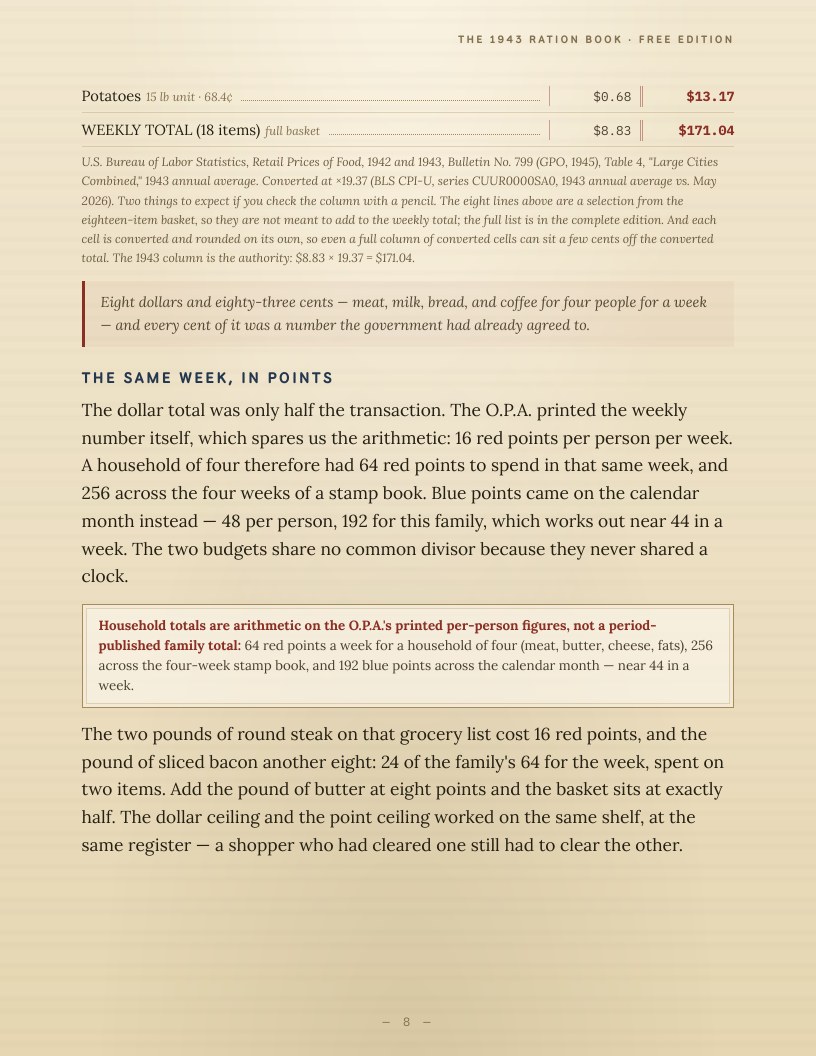
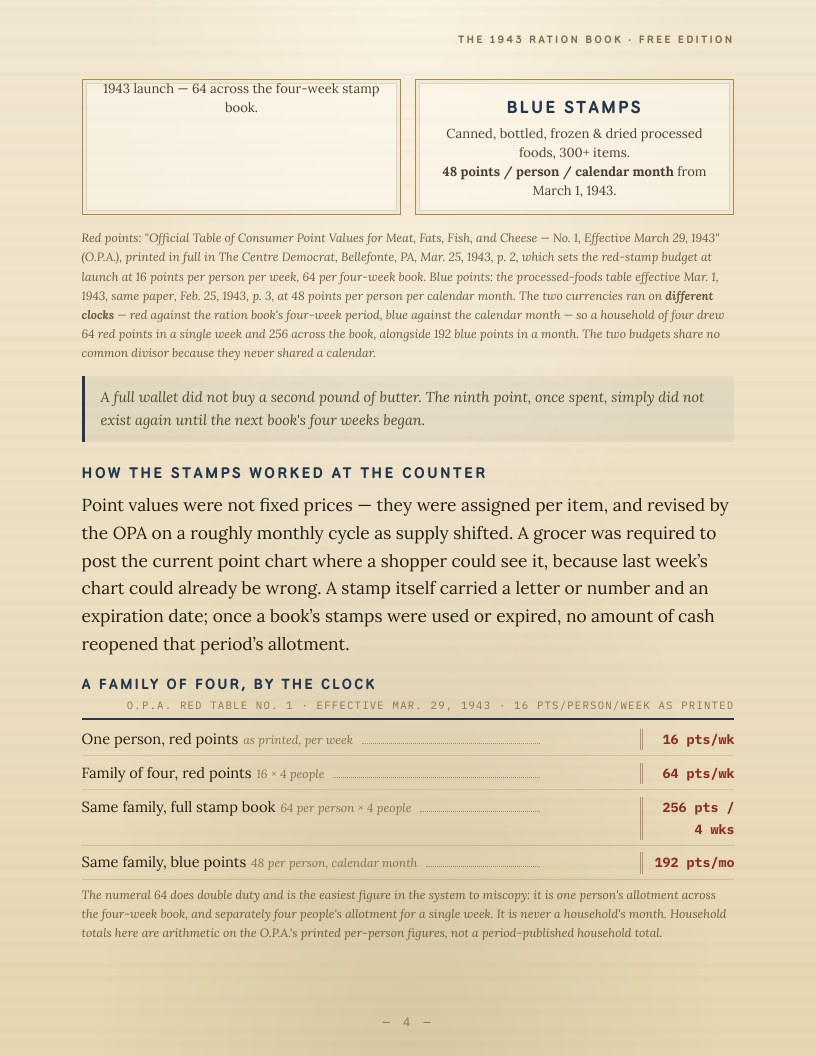
Sources: B.L.S. Bulletin 799 (1945), Table 4, 1943 annual average; O.P.A. Red Table Nº 1, effective March 29, 1943 (16 points per person per week); and, for the private’s pay, a published military pay chart compiled from War Department tables — a secondary compilation, named as one in the book. Today-dollar figures are rounded down to the whole dollar: at the B.L.S. CPI-U multiplier for 1943 (×19.37), the week’s basket converts to $171.04 and the private’s pay to $968.50.
What’s Inside the Booklet
A reader’s edition of the OPA’s own ration orders and the Bureau of Labor Statistics’ wartime bulletins — the system every American household ran on, 1943 to 1945.
The Four War Ration Books
Four booklets, four different rules — including the one nobody remembers: a fifth book the government printed but never had to issue.
The Point System
Red points and blue points — and the arithmetic that made a full pound of butter cost three points more than the cheaper spread sitting next to it.
What a Week’s Groceries Cost
A week’s basket in 1943 — shown in ration points, in 1943 dollars, and in today’s dollars, side by side.
How to Read a Stamp Today
A field guide for the ration books families still keep in a drawer — what each mark meant, so the keepsake makes sense again.
Not memory. Not folklore. The record itself.
Where the Numbers Come From
“Average retail prices of principal articles of food in large cities combined, by months, 1942 and 1943” — TITLE OF TABLE 4, B.L.S. BULLETIN Nº 799 (G.P.O., 1945)
That table is a price list, not a grocery bill — cents per pound, per quart, per dozen. So we did the shopping. Working from Table 4 at the 1943 annual average, we priced one week for a household of four, line by line, eighteen items in all, and the column adds to $8.83. Their prices; our addition. At the B.L.S. CPI-U multiplier for 1943 (×19.37), that week converts to $171.04 in today’s money. The booklet prints the basket with the bulletin, the table and the year set beside it, so every figure in it can be walked back to the government’s own document.
- Every point value is transcribed from the O.P.A.’s own printed tables — the Red Table Nº 1, effective March 29, 1943, and the Processed Foods table, effective March 1, 1943 — not from internet lists.
- Wage and price figures drawn from the Bureau of Labor Statistics’ own bulletins, via FRASER at the St. Louis Fed.
- Every figure in this booklet carries its source on the page — bulletin or ration order, table, and year — so you can check us against the record. Where the arithmetic is ours and not the government’s, we say so.
- You can read the whole bibliography before you give us an email address: every order, bulletin and archive record the books rest on is published in full on the sources page. And when we get something wrong, it goes on the correction log — dated, with the source that settled it. That page is not empty.
| Round steak, per lb. | 8 pts |
| Hamburger, per lb. | 5 pts |
| Peas, canned, No. 2 can | 16 pts |
| Pineapple, canned, No. 2½ can | 24 pts |
Fair Questions
The questions a careful buyer ought to ask. We’d ask them too.
Is it really free?
What format is it? Can I print it?
What happens after I sign up?
The Record Is Waiting.
Get the booklet, print it, and let 1943 start the conversation.